By Richard Prouse ·
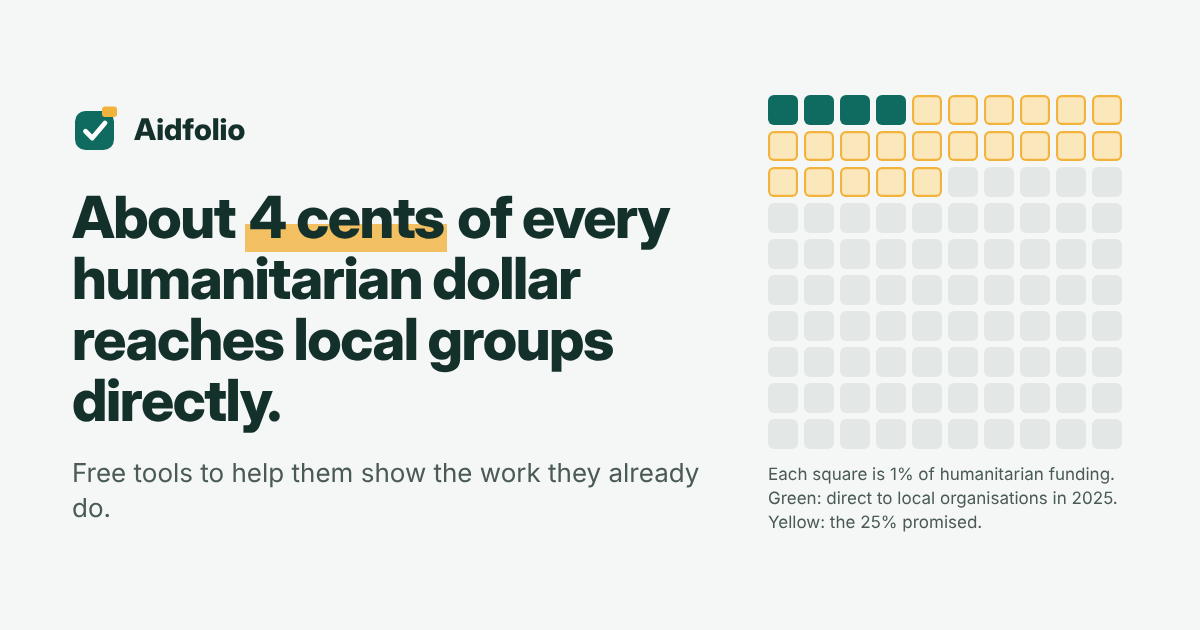
When a flood, an earthquake or a war hits, local organisations are the first to respond and the last to leave. They know the language, the roads and the people. Yet in 2025 only 4.3% of international humanitarian funding went directly to local and national organisations, a decade after donors and aid agencies promised at least 25% in the Grand Bargain.
The gap is getting wider. Total humanitarian funding fell 20% in 2025, to its lowest level in a decade, and funding that reached local organisations, directly or through partners, fell faster.
The paperwork wall
There are many reasons, but one comes up again and again: paperwork. Before a UN agency or an international NGO funds a local organisation, it runs an assessment. A UN HACT micro-assessment. A UN PSEA capacity assessment. An INGO’s own due-diligence form. Each asks similar questions in a different format, and each new partner starts again.
One local organisation with three staff wrote 21 policies just to pass a due-diligence check.
From a 2025 learning report on due diligence in Ukraine, where only 38% of NGOs surveyed felt due diligence was proportionate to their size.
Organisations that do excellent work can fail an assessment simply because they cannot show it in the expected format, or because no one told them what the assessor would ask for.
What Aidfolio does
Aidfolio is a free set of tools that helps local organisations show the work they already do:
- Readiness check: in about 30 minutes, describe how you work and list the 41 documents assessors most often ask for. Leave with a readiness pack, a dated action plan, and a summary organised the way the Charter for Change due-diligence passport is.
- Fair cost: work out your true overhead rate, see what your grants leave unfunded, and get a short brief to negotiate a fair overhead.
- Risk-sharing plan: prepare a fair conversation with your donor about who carries each risk and what support would share it.
- Toolbox and guides: 27 hand-picked free resources, and plain guides to HACT, UN PSEA and the due-diligence passport.
Built to be trusted
Aidfolio runs entirely in the browser, works on a phone and keeps working offline. Nothing anyone types is uploaded; there is no account and no data to sell or lose. It never invents a policy an organisation does not have: if something is missing, the pack says so plainly and suggests a first step. It is a self-assessment, not a certification, and it is not affiliated with the UN, Charter for Change or any donor. The code is open source.
Why I built it
“Local organisations already do remarkable work with very little. What they often lack is the time and money to prove it in the format each donor wants. Aidfolio won’t fix the funding system on its own, but it can turn the first assessment from a wall into a door.”
Richard Prouse, founder of Aidfolio
Aidfolio is built and run independently, unpaid, from New Zealand. It is free for every local organisation, always, and every dollar in and out is published in a monthly ledger.
What comes next
Sinhala, Tamil, French and Arabic versions, each translated and tested with local organisations. Testing with organisations preparing for real assessments. And, with their permission, the first open evidence on what local work really costs.
How you can help
- Send it to one local organisation that is facing a donor or UN partner assessment. That single message is the most useful thing you can do.
- If you work for an INGO, UN agency or pooled fund, share it with your partners before you assess them. We can map it to your own form.
- Help translate or test a language with local organisations: email richard@aidfolio.org.
- Support the work with a gift through Stripe.